
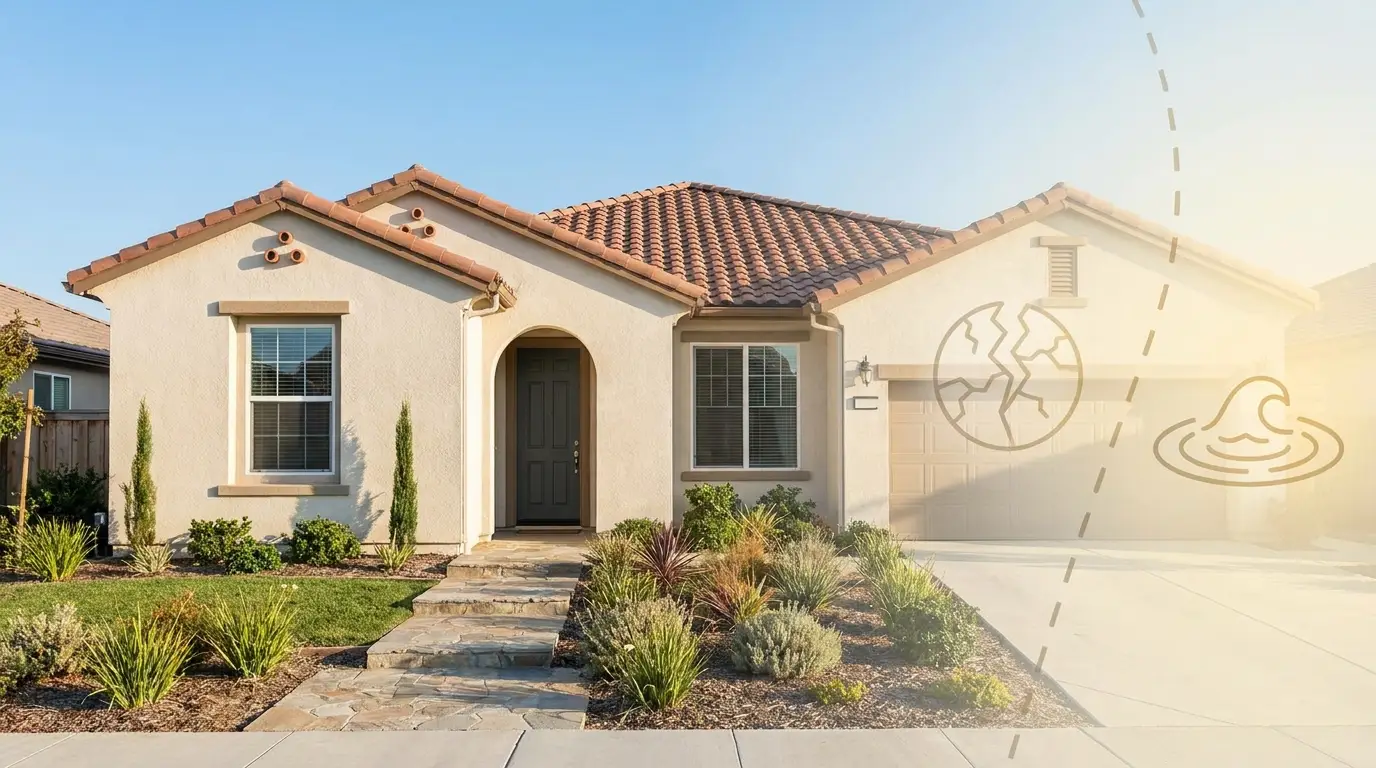
Note on scope: This article describes the general structure of a standard California homeowners policy (HO3 form). Exclusions and coverage options vary by policy and carrier. Nothing here is a coverage guarantee or a statement about any specific policy. Source: California Department of Insurance, Residential Insurance: Homeowners and Renters.
How a standard California homeowners policy is structured
A standard California homeowners policy (HO3 form) is generally an "open peril" or "all-risk" policy for the dwelling — meaning damage is covered unless the policy specifically excludes it. But the exclusion list is substantial. Understanding what sits on that list is just as important as knowing what is covered.
The broad coverage of an HO3 can give homeowners a false sense of security. Because the policy covers most causes of loss, it is easy to assume it covers all of them. The exclusions — many of which are standard across the admitted market — create real gaps that may not surface until a claim is filed.
The California Department of Insurance lists the following among the perils not covered by a standard homeowners policy: flood, earthquake, earth movement, termites, insects or rodents, water damage from seepage or leaks, mold, wear and tear or maintenance, war, nuclear hazard, and neglect. (CDI Residential Insurance Guide.) The following sections address the most consequential exclusions — and what a homeowner can do about each one.
Exclusion 1: Earthquake — not covered; separate policy required
Earthquake damage is typically excluded from standard California homeowners policies. California law requires every insurer that writes your homeowners coverage to offer earthquake insurance separately, at an additional premium. The California Earthquake Authority (CEA) provides most of this coverage, accessed through member insurers. Source: California Department of Insurance.
California sits atop a seismically active fault system, yet most homeowners carry no earthquake coverage. The exclusion is nearly universal in the admitted market: standard policies do not pay for structural damage, personal property loss, or additional living expenses caused by ground shaking.
The path forward is a separate earthquake policy. California law obligates your homeowners insurer to offer you earthquake coverage in writing — either directly or through the California Earthquake Authority (CEA), a publicly managed, privately funded entity that provides the majority of residential earthquake insurance in the state. You cannot buy directly from the CEA; coverage is accessed through member insurance companies.
For a deeper look at what an earthquake policy covers, the deductible structure, and how to think about whether it makes sense for your property, see our full guide: Do I need earthquake insurance in California?
Source: California Department of Insurance, Earthquake Insurance, insurance.ca.gov. California Earthquake Authority: earthquakeauthority.com.
Exclusion 2: Flood — not covered; separate flood policy required
Standard California homeowners policies do not cover flood damage. This includes damage from rising surface water, storm surge, and overflowing rivers or streams. Separate flood insurance is available through the National Flood Insurance Program (NFIP), administered by FEMA, and from some private insurers. Mortgage lenders often require it in designated flood zones.
Flood and homeowners insurance are separate products. A standard policy will not pay for damage caused by water that comes from outside the structure — rising groundwater, overflowing bodies of water, surface runoff from heavy rain. The California Department of Insurance confirms that flood is a standard exclusion from residential policies.
Homeowners who want flood coverage must purchase it separately. The main options are:
- National Flood Insurance Program (NFIP) — a federal program administered by FEMA and sold through participating private insurers. If your property is in a Special Flood Hazard Area (a designated high-risk zone), your lender will typically require NFIP coverage.
- Private flood insurance — offered by some carriers outside the NFIP, often with broader terms or higher limits. Availability and pricing vary by location and insurer.
One important distinction: sudden and accidental water damage from inside the structure — such as a burst pipe or appliance leak — is generally treated differently from flood and may be covered under a standard policy.
Source: California Department of Insurance, Residential Insurance Guide, insurance.ca.gov.
Exclusion 3: Sewer and drain backup — typically not covered; endorsement available
Standard homeowners policies generally do not cover water that backs up through a sewer or drain, or damage from a failed sump pump. This is separate from the flood exclusion — it applies even to internal plumbing-related backups. An optional water backup endorsement can add this coverage; terms and limits vary by carrier and form.
Sewer backup is a distinct category from flood, and it is frequently misunderstood. A storm that overwhelms the municipal sewer system can push water backward through your drains; a sump pump can fail during a heavy rain event. Both scenarios typically fall outside the scope of a standard homeowners policy. The NAIC confirms that most homeowners policies offer limited or no coverage for sewer or drain backup, though an endorsement may add it. (NAIC, Insurance Topics: Homeowners Insurance.)
A water backup endorsement (sometimes called a “sewer and drain backup” or “service line” endorsement, depending on the carrier) can extend coverage to these events. What a given endorsement actually covers — and for how much — varies. Reviewing the endorsement language tells you whether a sump pump failure, a municipal backup, or both are included, and what the sublimit is.
Older homes, properties with basements, and homes in areas with aging municipal infrastructure are the situations where this gap is most worth examining. Whether an endorsement is available and what it costs depends on the carrier and the property.
Exclusion 4: Gradual wear and tear, maintenance, and neglect
Damage from gradual wear and tear, lack of maintenance, or neglect is excluded from standard California homeowners policies. Insurance covers sudden, accidental losses — not the predictable deterioration that comes with age and use. Deferred maintenance is the homeowner's responsibility and can also complicate claims for related sudden losses that do occur.
A roof that fails after years of deferred maintenance, pipes that corrode over time, paint that peels, or a foundation that settles — none of these are covered losses under a standard homeowners policy. The CDI’s residential insurance guide explicitly lists “wear and tear or maintenance” and “neglect” as standard exclusions.
The logic is consistent: insurance is designed to protect against unpredictable events, not the foreseeable deterioration that every structure experiences over time. Maintenance costs are known and manageable; they do not meet the definition of an insurable loss.
There is a practical reason beyond principle to keep up with maintenance. If a sudden, otherwise-covered loss occurs — a storm, a fire, a pipe burst — the insurer may examine whether pre-existing maintenance failures contributed to the damage. Deferred maintenance can narrow a claim or create a coverage dispute even for losses that would otherwise qualify.
There is no separate policy that covers wear and tear. The coverage solution here is ongoing maintenance, not a product you can buy.
Exclusion 5: Mold — often excluded or significantly limited
Mold is typically excluded or subject to sublimits under standard California homeowners policies. Some policies offer no mold coverage at all; others cover mold only when it results from a covered sudden water loss. An endorsement may extend coverage. What your specific policy says — not what you assume — is what controls.
Mold is listed as a standard exclusion in the CDI residential insurance guide. In practice, coverage for mold varies significantly across policies and carriers: some policies exclude it entirely, while others provide limited coverage — typically only when the mold is a direct result of a sudden, accidental water loss that the policy itself covers (such as a burst pipe). Even then, a sublimit commonly applies. The NAIC notes that most homeowners policies offer limited or no mold coverage, though an endorsement may add it.
The risk profile for mold tends to be highest in California coastal areas where humidity is elevated, and in any property that has experienced water intrusion — whether from a roof leak, a plumbing failure, or flooding. Mold is also expensive to remediate, which makes the coverage question worth answering before, not after, a problem appears.
If mold coverage matters for your property, the right move is to read your current policy’s exclusions section directly — not to rely on an assumption — and to ask your broker whether an endorsement is available and what it covers.
Wildfire: typically covered — but availability and terms vary
Fire — including wildfire — is typically listed as a covered peril in a standard California homeowners policy. But "covered" is not the same as "covered adequately." In higher-risk zones, some carriers have non-renewed existing policies or stopped writing new ones. If the private market declines your property, the California FAIR Plan is a named-peril last-resort option.
Unlike the exclusions above, wildfire is generally a covered peril — not a gap — in a standard California homeowners policy. Fire is one of the most basic named risks the policy is designed to address. The questions worth asking are not “is it covered?” but “is it covered adequately, and will my carrier still write my home?”
California’s wildfire environment has led a number of admitted carriers to restrict new policies or non-renew existing ones in zones they consider too exposed. For properties that cannot obtain coverage in the standard private market, the California FAIR Plan — a state-created insurer of last resort — provides basic named-peril fire coverage. The FAIR Plan does not include personal liability, water damage, theft, or earthquake coverage; most policyholders pair it with a “difference in conditions” (DIC) policy to fill those gaps.
The two coverage questions most relevant for wildfire:
- Is your dwelling limit high enough to fund a full rebuild? Coverage limits that were adequate when the policy was written may fall short of current construction costs. Rebuild cost — not market value — is the right benchmark.
- Is your carrier still writing in your area? A non-renewal notice can arrive before the next fire season. Knowing your options in advance gives you more time to find them.
For a complete guide to wildfire coverage, the FAIR Plan, and what a coverage review looks like, see: Does my homeowners insurance cover wildfire damage in California? and What is the California FAIR Plan — and do you have other options?
Common questions
Is earthquake damage covered by my California homeowners policy?
No — earthquake damage is typically excluded from standard California homeowners policies. California law requires your insurer to offer you earthquake coverage separately, for an additional premium. Coverage can be written by your existing insurer or through the California Earthquake Authority (CEA). Source: California Department of Insurance, insurance.ca.gov.
Does homeowners insurance cover flood damage?
Standard homeowners policies in California do not cover flood damage. Separate flood insurance is available through the National Flood Insurance Program (NFIP), administered by FEMA, and from some private insurers. If your property is in a designated flood zone, your mortgage lender may require flood coverage as a loan condition. Source: California Department of Insurance.
What is a water backup endorsement and do I need one?
A water backup (or sewer and drain backup) endorsement is an optional add-on that can cover damage from water backing up through sewers, drains, or a failed sump pump — damage generally excluded under a standard policy. Whether it makes sense depends on your property: an older home, a basement, or a low-lying lot are common reasons to consider it.
Why does homeowners insurance exclude wear and tear?
Insurance is designed for sudden, accidental losses — not for the predictable deterioration that comes from age and use. Gradual wear and tear, deferred maintenance, and neglect are treated as homeowner responsibilities, not insurable risks. Keeping up with maintenance also protects you from coverage disputes when a sudden loss does occur nearby.
Is wildfire covered by California homeowners insurance?
Fire — including wildfire — is typically a covered peril in a standard California homeowners policy. But in higher-risk areas some carriers have restricted new policies or non-renewed existing ones. If your home cannot be covered in the private market, the California FAIR Plan provides a named-peril last-resort option. Availability and terms vary; confirm with your broker.
How do I find out what my homeowners policy actually excludes?
Your declarations page lists your coverages and limits; the policy itself contains the full list of exclusions and conditions. Reading the exclusions section — usually found near the back of the policy document — tells you exactly what is not covered. An independent broker-agent can walk you through the key sections and flag any gaps relevant to your property and location.
Related: Home, condo & umbrella coverage · Homeowners insurance & your mortgage · When did you last read your policy? · The California FAIR Plan · Wildfire coverage in California · Earthquake insurance in California